VercelLogotypeVercelLogotype
LoginSign Up
Back to Templates

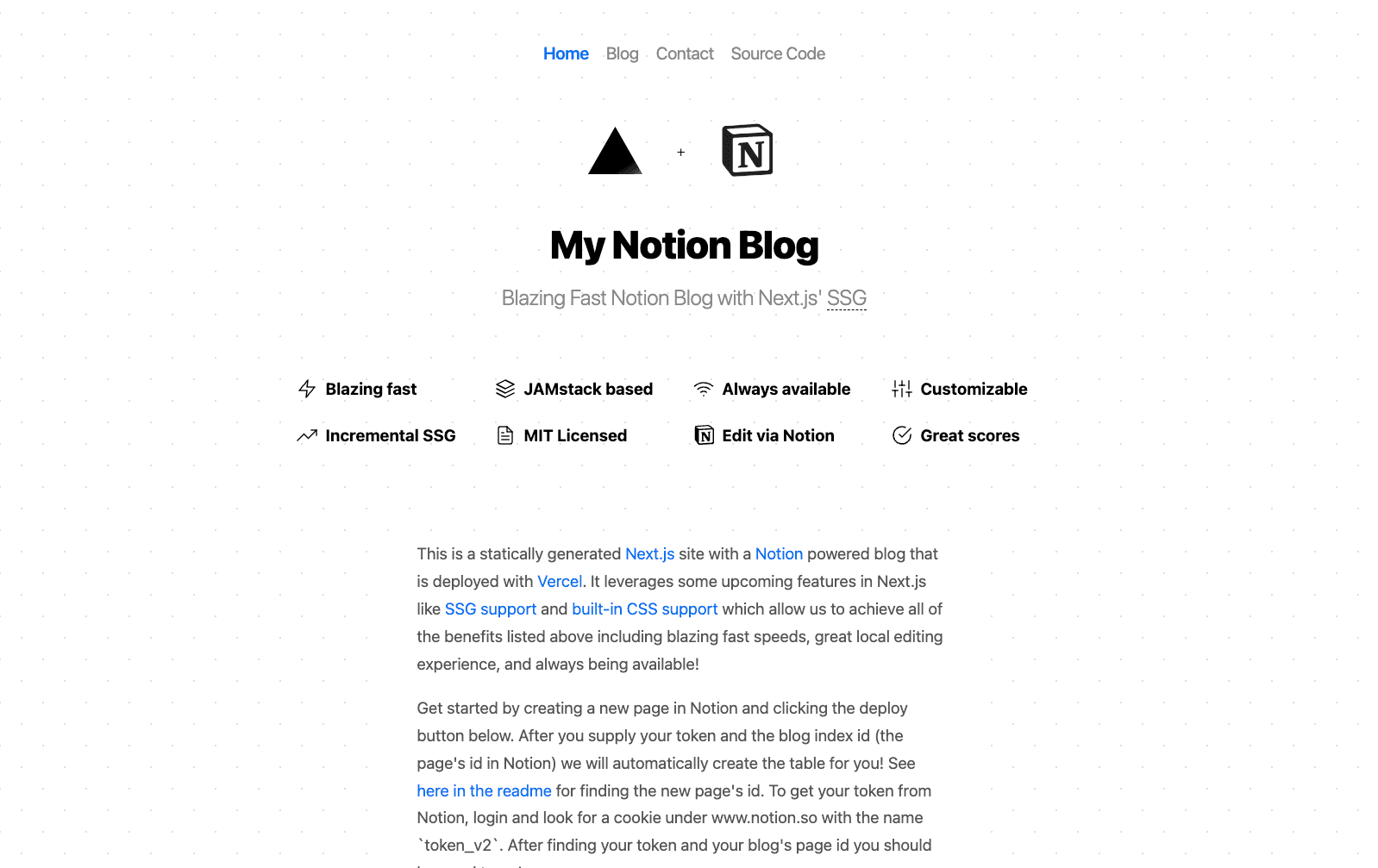
Notion-backed Next.js Blog

A Next.js site using new SSG support with a Notion backed blog

DeployView Demo
Notion-backed Next.js Blog

Notion Blog

This is an example Next.js project that shows Next.js' upcoming SSG (static-site generation) support using Notion's private API for a backend.

Note: This example uses the experimental SSG hooks only available in the Next.js canary branch! The APIs used within this example will change over time. Since it is using a private API and experimental features, use at your own risk as these things could change at any moment.

Live Example hosted on Vercel: https://notion-blog.vercel.app/

Getting Started

To view the steps to setup Notion to work with this example view the post at https://notion-blog.vercel.app/blog/my-first-post or follow the steps below.

Deploy Your Own

Deploy your own Notion blog with Vercel.

or

  1. Clone this repo git clone https://github.com/ijjk/notion-blog.git
  2. Configure project with vc
  3. Add your NOTION_TOKEN and BLOG_INDEX_ID as environment variables in your project. See here for how to find these values
  4. Do final deployment with vc

Note: if redeploying with vc locally and you haven't made any changes to the application's source and only edited in Notion you will need use vc -f to bypass build de-duping

Creating Your Pages Table

Note: this is auto run if a table isn't detected the first time visiting /blog

Using the Pre-Configured Script

  1. Create a blank page in Notion
  2. Clone this repo git clone https://github.com/ijjk/notion-blog.git
  3. Install dependencies cd notion-blog && yarn
  4. Run script to create table NOTION_TOKEN='token' BLOG_INDEX_ID='new-page-id' node scripts/create-table.js See here for finding the id for the new page

Manually Creating the Table

  1. Create a blank page in Notion
  2. Create a inline table on that page, don't use a full page table as it requires querying differently
  3. Add the below fields to the table

The table should have the following properties:

  • Page: this the blog post's page
  • Slug: this is the blog post's slug relative to /blog, it should be a text property
  • Published: this filters blog posts in production, it should be a checkbox property
  • Date: this is when the blog post appears as posted, it should be a date property
  • Authors: this is a list of Notion users that wrote the post, it should be a person property

Getting Blog Index and Token

To get your blog index value, open Notion and Navigate to the Notion page with the table you created above. While on this page you should be able to get the page id from either:

  • the URL, if the URL of your page is https://www.notion.so/Blog-S5qv1QbUzM1wxm3H3SZRQkupi7XjXTul then your BLOG_INDEX_ID is S5qv1QbU-zM1w-xm3H-3SZR-Qkupi7XjXTul
  • the loadPageChunk request, if you open your developer console and go to the network tab then reload the page you should see a request for loadPageChunk and in the request payload you should see a pageId and that is your BLOG_INDEX_ID

To get your Notion token, open Notion and look for the token_v2 cookie.

Creating Blog Posts

  1. In Notion click new on the table to add a new row
  2. Fill in the Page name, slug, Date, and Authors
  3. At the top of the content area add the content you want to show as a preview (keep this under 2 paragraphs)
  4. Add a divider block under your preview content
  5. Add the rest of your content under the divider block

Running Locally

To run the project locally you need to follow steps 1 and 2 of deploying and then follow the below steps

  1. Install dependencies yarn
  2. Expose NOTION_TOKEN and BLOG_INDEX_ID in your environment export NOTION_TOKEN='<your-token>'and export BLOG_INDEX_ID='<your-blog-index-id>' or set NOTION_TOKEN="<your-token>" && set BLOG_INDEX_ID="<your-blog-index-id>" for Windows
  3. Run next in development mode yarn dev
  4. Build and run in production mode yarn build && yarn start

Credits

  • Guillermo Rauch @rauchg for the initial idea
  • Shu Ding @shuding_ for the design help
  • Luis Alvarez @luis_fades for design help and bug catching

GitHub Repoijjk/notion-blog
LicenseView License
Use Cases
BlogCMS
Stack
Next.jsCSS Modules
CMS
Notion

Related Templates

Get Started

  • Templates
  • Supported frameworks
  • Marketplace
  • Domains

Build

  • Next.js on Vercel
  • Turborepo
  • v0

Scale

  • Content delivery network
  • Fluid compute
  • CI/CD
  • Observability
  • AI GatewayNew
  • Vercel AgentNew

Secure

  • Platform security
  • Web Application Firewall
  • Bot management
  • BotID
  • SandboxNew

Resources

  • Pricing
  • Customers
  • Enterprise
  • Articles
  • Startups
  • Solution partners

Learn

  • Docs
  • Blog
  • Changelog
  • Knowledge Base
  • Academy
  • Community

Frameworks

  • Next.js
  • Nuxt
  • Svelte
  • Nitro
  • Turbo

SDKs

  • AI SDK
  • Workflow SDKNew
  • Flags SDK
  • Chat SDK
  • Streamdown AINew

Use Cases

  • Composable commerce
  • Multi-tenant platforms
  • Web apps
  • Marketing sites
  • Platform engineers
  • Design engineers

Company

  • About
  • Careers
  • Help
  • Press
  • Legal
  • Privacy Policy

Community

  • Open source program
  • Events
  • Shipped on Vercel
  • GitHub
  • LinkedIn
  • X
  • YouTube

Loading status…

Select a display theme:
    • AI Cloud
      • v0

        Build applications with AI

      • AI SDK

        The AI Toolkit for TypeScript

      • AI Gateway

        One endpoint, all your models

      • Vercel Agent

        An agent that knows your stack

      • Sandbox

        AI workflows in live environments

    • Core Platform
      • CI/CD

        Helping teams ship 6× faster

      • Content Delivery

        Fast, scalable, and reliable

      • Fluid Compute

        Servers, in serverless form

      • Observability

        Trace every step

    • Security
      • Bot Management

        Scalable bot protection

      • BotID

        Invisible CAPTCHA

      • Platform Security

        DDoS Protection, Firewall

      • Web Application Firewall

        Granular, custom protection

    • Company
      • Customers

        Trusted by the best teams

      • Blog

        The latest posts and changes

      • Changelog

        See what shipped

      • Press

        Read the latest news

      • Events

        Join us at an event

    • Learn
      • Docs

        Vercel documentation

      • Academy

        Linear courses to level up

      • Knowledge Base

        Find help quickly

      • Community

        Join the conversation

    • Open Source
      • Next.js

        The native Next.js platform

      • Nuxt

        The progressive web framework

      • Svelte

        The web’s efficient UI framework

      • Turborepo

        Speed with Enterprise scale

    • Use Cases
      • AI Apps

        Deploy at the speed of AI

      • Composable Commerce

        Power storefronts that convert

      • Marketing Sites

        Launch campaigns fast

      • Multi-tenant Platforms

        Scale apps with one codebase

      • Web Apps

        Ship features, not infrastructure

    • Tools
      • Marketplace

        Extend and automate workflows

      • Templates

        Jumpstart app development

      • Partner Finder

        Get help from solution partners

    • Users
      • Platform Engineers

        Automate away repetition

      • Design Engineers

        Deploy for every idea

  • Enterprise
  • Pricing
Log InContact
Sign Up
Sign Up
Back to Templates
DeployView Demo

Blog Starter Kit

A statically generated blog example using Next.js and Markdown.
Blog Starter Kit

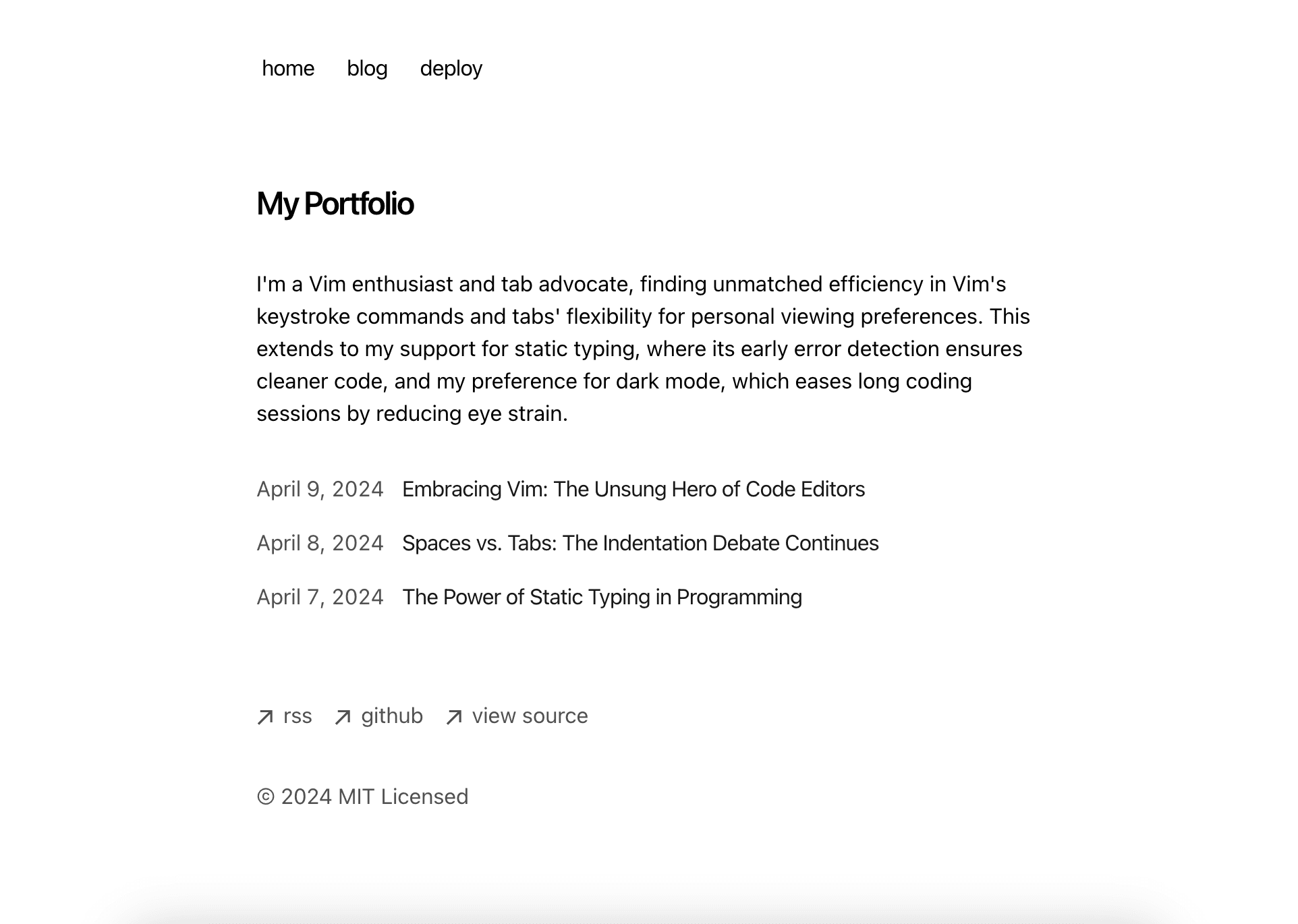
Next.js Portfolio with Blog

Easily create a portfolio with Next.js and Markdown.
Next.js Portfolio with Blog

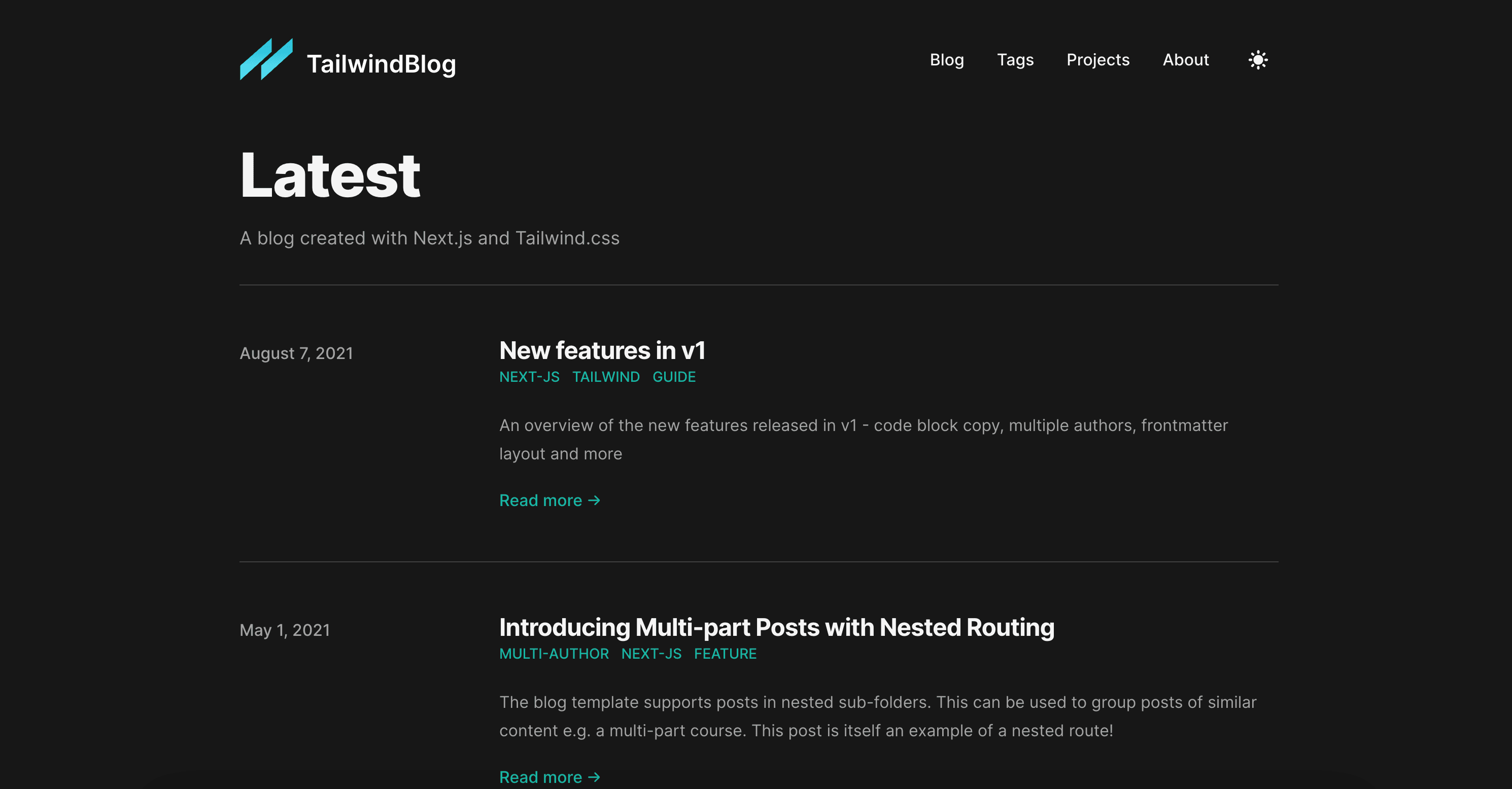
Tailwind CSS Blog

Next.js blog using Markdown for content.
Tailwind CSS Blog
v0

Build applications with AI

AI SDK

The AI Toolkit for TypeScript

AI Gateway

One endpoint, all your models

Vercel Agent

An agent that knows your stack

Sandbox

AI workflows in live environments

CI/CD

Helping teams ship 6× faster

Content Delivery

Fast, scalable, and reliable

Fluid Compute

Servers, in serverless form

Observability

Trace every step

Bot Management

Scalable bot protection

BotID

Invisible CAPTCHA

Platform Security

DDoS Protection, Firewall

Web Application Firewall

Granular, custom protection

Customers

Trusted by the best teams

Blog

The latest posts and changes

Changelog

See what shipped

Press

Read the latest news

Events

Join us at an event

Docs

Vercel documentation

Academy

Linear courses to level up

Knowledge Base

Find help quickly

Community

Join the conversation

Next.js

The native Next.js platform

Nuxt

The progressive web framework

Svelte

The web’s efficient UI framework

Turborepo

Speed with Enterprise scale

AI Apps

Deploy at the speed of AI

Composable Commerce

Power storefronts that convert

Marketing Sites

Launch campaigns fast

Multi-tenant Platforms

Scale apps with one codebase

Web Apps

Ship features, not infrastructure

Marketplace

Extend and automate workflows

Templates

Jumpstart app development

Partner Finder

Get help from solution partners

Platform Engineers

Automate away repetition

Design Engineers

Deploy for every idea